Blog
Desi Ghee vs Refined Oils: Which Is Healthier for Daily Cooking?
Jan
Every Pakistani kitchen faces this debate: the traditional desi ghee our grandmothers swore by, or the modern refined oils marketed as “light” and “cholesterol-free.” Both have a place — but they’re very different foods. Here’s the honest comparison, so you can decide what belongs in your karahi.
What is the difference between desi ghee and refined oil?
Desi ghee is clarified butter — milk fat simmered until the water and milk solids separate out, leaving pure butterfat. Refined oil is plant oil (soybean, canola, sunflower) extracted with solvents and then bleached, deodorized and chemically refined. One is a traditional whole food; the other is a heavily processed industrial product.
That processing gap matters. Pure desi ghee contains butyric acid, fat-soluble vitamins A, D, E and K, and conjugated linoleic acid (CLA). Refined oils are mostly omega-6 polyunsaturated fats with the natural vitamin E stripped out during refining — which is why manufacturers add synthetic antioxidants back in.
Desi ghee vs refined oil: head-to-head comparison
| Factor | Pure Desi Ghee | Refined Cooking Oil |
|---|---|---|
| Smoke point | ~250°C (excellent for frying/tarka) | ~230°C (varies by type) |
| Processing | Traditionally slow-cooked, minimal | Solvent-extracted, bleached, deodorized |
| Key fats | Saturated + monounsaturated, CLA, butyric acid | Mostly omega-6 polyunsaturated |
| Vitamins | A, D, E, K naturally present | Natural vitamin E lost in refining |
| Flavour | Rich, nutty, aromatic | Neutral/bland |
| Shelf life | 12+ months without refrigeration | 6–12 months |
| Typical price (Pakistan) | Higher (purity costs) | Cheaper |
Which is healthier for daily cooking?
For high-heat Pakistani cooking — tarka, frying, parathas — pure desi ghee is the healthier choice. Its high smoke point means it stays stable instead of breaking down into harmful compounds, and it delivers fat-soluble vitamins refined oils lack.
The old fear was cholesterol: ghee is high in saturated fat, and for decades that made it the villain. Current nutrition science is more nuanced — moderate saturated fat from whole-food sources, as part of a balanced diet, is not the heart-disease driver it was once claimed to be. The real dietary villain is excess omega-6 from refined seed oils combined with sugar and processed food.
That said, ghee is calorie-dense (about 112 calories per tablespoon). The healthy pattern is: cook daily food in modest amounts of pure desi ghee, and keep total fat moderate. Two to three teaspoons per person per day is a sensible range for most households.
Is desi ghee bad for cholesterol?
Not inherently. Studies on moderate ghee consumption show neutral to slightly positive effects on lipid profiles, partly thanks to CLA and butyric acid. Problems arise from excess — drowning every meal in ghee — not from normal use.
If you have diagnosed high cholesterol or heart disease, follow your doctor’s advice on fats. For everyone else, replacing refined oil with moderate pure ghee is a step toward less-processed eating, not away from it.
When should you still use refined oil?
Refined oil makes sense where you want zero flavour interference — like baking cakes — or when budget is the deciding factor. It’s also fine for low-heat salad dressings if you choose a cold-pressed (not refined) version.
The practical Pakistani kitchen answer: ghee for tarka, frying and parathas; a good cold-pressed oil (like mustard or sesame) for everything else; refined oil only when nothing else is available.
How do you identify pure desi ghee? (Don’t get fooled)
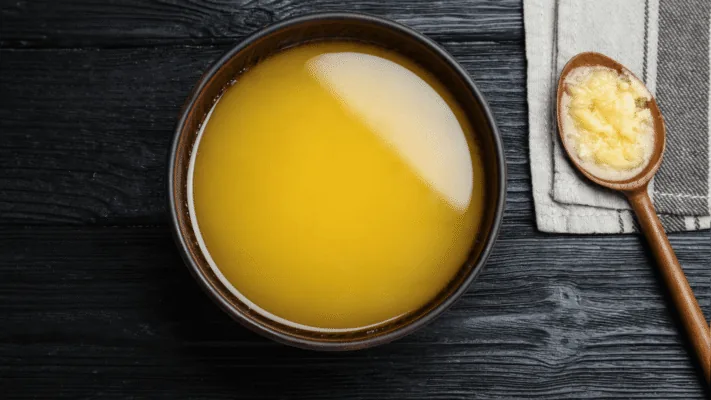
Pure desi ghee has a granular texture, a nutty aroma and a golden colour. It melts completely without residue. If it smells flat, looks uniformly waxy, or lists “vegetable oil” or “vanaspati” anywhere, it’s not pure.
This matters because fake ghee is rampant — vanaspati (hydrogenated vegetable fat) is often sold as desi ghee at half the price, and it’s far worse for your health than either real ghee or refined oil. Read our full guide on how to identify pure organic foods and avoid adulterated products before you buy.
Where to buy pure desi ghee in Pakistan?
Buy from a seller that makes it the traditional way — slow-cooked from pure cow’s milk, with no vanaspati, no additives and no shortcuts. Our desi ghee is small-batch and traditionally prepared, Rs 2,000 with Cash on Delivery across Pakistan. One sniff of the real thing and you’ll never confuse it with vanaspati again.
Frequently Asked Questions
Can I cook everything in desi ghee?
Yes for most Pakistani cooking — its 250°C smoke point handles tarka, frying and roasting easily. For baking where you want neutral flavour, a neutral oil works better.
How much desi ghee per day is healthy?
About 2–3 teaspoons per person daily fits comfortably into a balanced diet. More than that regularly adds excess calories regardless of the fat’s quality.
Is vanaspati the same as desi ghee?
No — and this confusion is dangerous. Vanaspati is hydrogenated vegetable oil containing trans fats, which are strongly linked to heart disease. Real desi ghee contains no trans fats. Never substitute one for the other.
Does desi ghee need refrigeration?
No. Stored in a cool, dry place away from sunlight, pure desi ghee keeps for 12 months or more without refrigeration.
What is the price of pure desi ghee in Pakistan?
Pure desi ghee typically costs significantly more than refined oil or vanaspati — purity costs. Ours is Rs 2,000 for 500gm and Rs 4,000 for 1kg with Cash on Delivery nationwide.
About The Only Tasty: our team sources raw honey, desi ghee and dry fruits directly from farms across Pakistan. We write about food purity because we’ve seen what the fake stuff does to trust.

Pingback: How to Identify Pure Food & Avoid Adulteration (Guide)